
Can I achieve a neat and cost effective hydraulic that runs on and on?
Real world hacks that hydraulic designers use every time to make their projects a win.

A very neat hydraulic installation in a JCB131X excavator.
Don’t we all want our hydraulic system to be neat, come in at a good price and run on and on? We might aspire to an installation as neat as a JCB excavator but will have to compromise somewhere if we aren’t on a big budget. Let’s look at three basics.
Neat is tricky. Is it all down to experience in designing hydraulics? Not entirely. We are discussing some hacks to make unit neater. Our starting point is laying a unit out with the easiest connections between components. That is probably the minimum runs of pipework and hoses. Cut the count on fittings as well. Multi- part adaptors or very tight spaces aren’t going to be very neat either. A petrochemical plant that is full of meticulous pipework may look incredible. Too much pipework and lots of fittings on a small hydraulic unit bulk up the size, make it look messy and cost a lot of money. We would strive to simplify them. We would do our best. There are some ideas further on.
Cost is tricky. Where do you start? A one off will always cost more than numbers. There is a learning curve on a new unit anyway and this translates into cost. Invest more in design up front and you should make production easier, provided somebody has the experience. As noted in our point on neatness, lots of fittings and pipework cost a dreadful amount of money. Simplify the unit. Our suggestion is always to buy decent quality and not cheap and nasty. Hydraulic parts are expensive. Shopping around may get the cost of parts down, but make sure it isn’t at the expense of reliability.
Finally, reliability. A troublesome unit may be technical issues where something isn’t working quite as you expected. That’s development. Don’t let that challenge be made worse by poor quality parts. Over decades, we have always used decent names like Parker Hannifin, Rexroth and the major manufacturers. Pattern parts from the Far East are massively cheaper. The choice is yours.
Four hacks that hydraulic designers use to make a difference on their neat but cost effective design.
After over four decades of manufacturing our Micropac hydraulic pumps, we have seen lots of clever design angles. The principles here apply to other hydraulic parts including filters, pumps, valve, gauges and accumulators.
How does using a panel change my design?

Don’t underestimate how much kit like this Trumpf laser can transform your designs. Laser cut profiles then folding open up exciting opportunities for neat hydraulic units.
Clever sheet metal can change your design massively for the better. Look very seriously whether it can work for you.
In a world of amazingly accurate laser cut profiles and CNC folding, basing your design around sheet metal is a very powerful design tool. It has worked very well for us. The finished job can be incredibly neat. Add in the ability to mount hydraulic parts on panels and you can quietly build up all the components then connect them up where needed. Make sure you leave room for access even if it means having removable panels. The costs can often work even for one off and production can be driven from CAD files rather than dimensioned 2D drawings. That’s quite important.

Our innovative MPP Panel Pump. The 316 handle shaft, handle (removed here) and release knob are the opposite side. What you see here is inside the reservoir or behind a panel away from a harsh environment.
Maybe our big issue as hand pump manufacturers is mounting a hand pump so that the reaction from using the handle can be taken up mechanically. Good sheet metal design can provide strong mountings for any part where there is a mechanical loading. We would always look to sheet metal as the first port of call before diving into a welded frame. Invariably that welded option will be more expensive and higher mass. This same point applies to lots of other components. Hand pumps most certainly need a rigid mounting whilst being used. Also think of other applications of high loads like unscrewing the bowl on a filter during maintenance to swap out the element or moving a fairly high torque control lever on a ball valve. You can’t just leave these supported only by pipework.
One final thought with a panel mount for hydraulic components is keeping connections out of view behind a panel for cosmetic reasons. That’s a nice design touch. Beyond that is the rather clever option of making one side of a panel suitable for harsh environments and the other side sealed and using anodised alloy or carbon steel parts to drive costs down. Our own MPP panel pump is used on marine applications like yacht hydraulics and Ground Support Equipment. The operator sees only a 316 stainless operating handle and a release valve knob on the “business” side of the panel, which can be the yacht bulkhead, a panel on an offshore installation or just a reservoir side. Behind the panel and sealed from the marine environment is the pump body, relief valve and connections. Apply this same idea elsewhere on your design. It works very well for pressure gauges as well, with a plain hole and back clamp. Our friends Ashford Instrumentation will supply gauges with “panel mount with back clamp”, a “three hole front flange” or “three hole back flange.” Specialist multi way ball valves also mount neatly behind panels but do order the “panel mount” option otherwise the installation is a mess. Our own kit uses superb Hoke Multimite 316 ball valves neatly mounted behind panels. Beautiful kit.
How is mounting hydraulic components on a reservoir lid and maybe piping up from underneath is a massive winner?

Connections and components under the reservoir lid can provide a winning design. This Micropac special unit was a great success.
Let’s pursue the hack of using the inside of a reservoir for connections or even hydraulic parts. Our biggest win is having everything mounted on or under a reservoir lid so it can be built as a neat module then simply fitted to a sheet metal reservoir and sealed around the flange on the lid.
Should I look at a custom reservoir?

Our Micropac 2.5 fixed catalogue hydraulic reservoir for smaller systems
Yes, keep this in mind. It can be a great option. It may make the job a lot neater or offer savings and benefits. Folded steel hydraulic oil reservoirs are cheap and made in massive numbers. But you buy what is in the catalogue. We are already suggesting that you might consider using a catalogue reservoir then obtaining a new laser cut lid so you can mount up all your hydraulic components. There may be a very good reason for getting a custom reservoir made. You might want to fit the available space better. You could make the top plate larger to fit your hydraulic parts. You might want mountings other than the standard catalogue base flanges. That would be a lot neater than making some sort of adaptor plate to make a catalogue reservoir fit the job. For many of our customers, even the smallest catalogue reservoir is simply too large. Finally, do consider using 304 stainless or even 316 to avoid painting a reservoir. Painting costs money and preparation of the metal surface is quite demanding. Sarum Hydraulics manufacturers a large range of standard reservoirs for our Micropac pumps. We offer catalogue fixed reservoirs for hydraulic system builders ranging from 2.5 to 50 litres and we can also provide custom reservoirs. Learn more about Micropac reservoirs for your hydraulic unit. Contact us to talk about your reservoir requirement.
Will using a hydraulic manifold provide benefits?

A typical manifold block. Courtesy Hedley Hydraulics
In the right application, manifolds are very powerful. You can shrink down an installation if you aren’t forced to use hoses or compression fittings to link discrete parts. Clever design can use drillings within the manifold to provide all the flow paths.
Valves and ancillary hydraulic parts can be mounted using a flat interface with o ring ports and tapped holes as the CETOP standard or using threaded female ports with multiple connections breaking into a parallel axial bore. For example, our own Micropac MT series C10-2 cartridge hand pump uses the 7/8UNF thread with the tank connection on the nose of the pump body and the pressure on the side of the body inside the cavity. These are massively economic and take seconds to fit or swap out. The same is true with hydraulic cartridge valves from suppliers like Parker Hannifin or Bosch Rexroth.
CETOP mounted valves and alternative connection using a flat face with o ring sealing is also very powerful in designing hydraulics. Look at a hydraulic power pack using a motor, “end head”, gear pump and reservoir and you see a very cost effective solution. The end head manifold block may be machined for threaded cartridge valve cavities for specific valves (bearing in mind these can be blanked if not required) plus also offering flat face CETOP connection of a valve stack or our own MQ series CETOP 2 hydraulic hand pump.
Yes, hydraulic manifolds are a powerful design solution. Keep in mind that there are catalogue manifolds that will integrate a number of CETOP or cartridge valves. There is also the opportunity to design your own manifold or have one designed. Our only observation is that people who design and machine manifolds get very good at it. We’d stick to somebody who is good. Don’t overlook thermal deburring as an extra process. Lots of big users of hydraulics won’t touch a manifold block that has not been thermally deburred. We are great fans.
Can I design a custom manifold block for my hydraulic system? Yes, you can. Or somebody makes it for you. Our take is that manifold block designers are very good at what they do. The same is true of manifold block machine shops. The one off design and machining cost might put you off. Or it might be the only way of shrinking the size of your system. Pipework and hoses are bulky and the labour for piping is very expensive. It’s your choice. If you are selling numbers of a hydraulic unit, a special manifold would be our choice every time. It allows you to offer something that your competitors can’t. A truly innovative manifold design is a masterpiece. Contact us to talk about custom manifolds.

This Micropac unit uses a custom manifold block in 316 stainless to simplify complicated fittings and pipework, making the unit very neat. The idea has big benefits.
How do you design a hydraulic unit?
We are assuming that you know what the circuit is doing and know the parts that need to be integrated into the unit. What then?
Should I be buying in the knowhow?
We have talked about designing a hydraulic unit. Should you be designing it or somebody else? Asking an expert takes out a whole chunk of risk. Maybe this costs money, but this is not always the case if you buy in a few parts already integrated together. For example, if we wanted a small 12v power pack, Hydra Products would be first port of call. These small packs integrate the motor, pump and reservoir all coupled by an “end head” manifold that accommodates the basic valves, acts as the bellhousing and is also a platform for CETOP components like our innovative MQ CETOP hand pump. That is a cheaper option than buying in all the parts individually. There is always a business decision in buying in a more complicated hydraulic unit finished. That’s definitely attractive for a one off system for your shop, but at a price. A manufacturer who proposes to sell a lot of any product will tell you that buying in a finished product from somebody else might not work unless it is a small part of a much bigger unit. Swallowing two mark-ups on a final selling price might not work commercially. But there are exceptions. Every product is different.
How can Sarum Hydraulics help you?

Micropac catalogue MW unit ready for reservoir mounting or piping into your hydraulic system.

Micropac MW pump & 50 litre reservoir can provide the base for your own system built around our top plate

Micropac custom pump & reservoir using our components for a valve actuator.
We have been manufacturing our Micropac hydraulics for over four decades. The catalogue pumps like the MW unit have been there since day one. Over this time, we have also designed a developed lots of innovative hydraulics, invariably based around a clever manifold incorporating our hand pump parts then adding extra functionality for a customer. For example, our pumps are used in massive numbers of public service vehicles and hydraulic crew seats. There are always numbers involved. We are OEM manufacturers. What we don’t get involved in is supplying electric hydraulic power packs. There are lots of firms who do this really well. It is very competitive. Our pumps have always been integrated into customers’ hydraulic power packs and hydraulic units. We will supply you one of our PTR-M air driven packs or our range of manual and air driven test rigs. We don’t offer run of the mill hydraulic power packs, although over the years have integrated other parts into our trolley units. There are specialists who do nothing other than design and manufacture different types of hydraulic unit. Talk to us about your specific hand pump application and we can advise your best way of making it happen.
Read more about each product mentioned in the article:
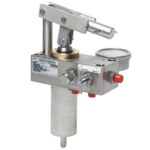
316 stainless, double acting operation to 700 bar, multi-fluid compatibility, configure to your requirements, range of fixed mount reservoirs 1-20 litre capacity.
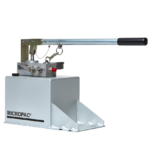
MW-3 or MW-A hand pump mounted on carry around portable or trolley mounted reservoir 5-50 litre capacity; configure to your requirements.
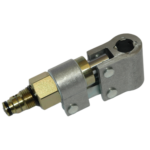
Manifold mounting cartridge style, for incorporation into a C10-2 industry-standard cavity. Configure to requirements with material and sealing options and displacements to suit pressures to 400 bar.
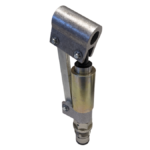
MTX C16 Cartridge Pump
Manifold mounting cartridge style, for incorporation into a C16-2 industry-standard cavity. Configure for requirements with material and sealing options; displacements to suit pressures to 200 bar
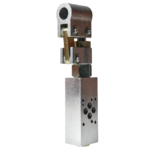
MT cartridge hand pump fitted to a CETOP slice manifold, for fitting to an end head or manifold valve stack. Cost effective solution compared to piped units.
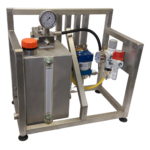
Pneumatic air driven hydraulic pump and stainless steel skid for benchtop operation. Configure for requirements with material and sealing options; pressures to 700 bar. Available as standalone, or with integral 10 or 20 litre reservoir.
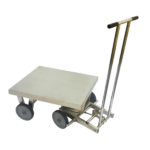
304 or 316 stainless steel construction for scrub and washdown applications within the chemical and food industries. Load platform for carrying and equipment mounting. Multiple sizes available; maximum load capacity 500kg.

Reservoir range to suit our MW and MD range hand pumps. Aluminium alloy and 316 stainless, capacity 1-50 litres in fixed and portable carry around or trolley mounted configurations. Options for fillers, additional bosses and level indicators.

Leave A Comment