
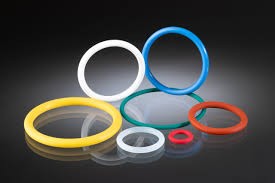
Assorted O Ring compounds. Image courtesy of Eastern Seals
Can I find a universal seal or is this chasing the Holy Grail of materials?
Wouldn’t it be amazing to order in your fluid power hydraulic pump with a single seal compound? A hydrostatic pressure test pump fill or charging unit that can be used on water, oil, glycols and skydrol with one universal seal. Forget choosing nitrile buna-N, viton or epdm. Is it that easy? The answer is yes and no. We have three materials that we will discuss. In addition, lots of hydraulic people wouldn’t understand why we even need to ask the question as they run on just one fluid. It is probably quite a specialist question. And there is more to it than just fluid and seal material.
My system runs on mineral oil, so what is the issue?
If you are running on mineral oil, then there probably is no issue. Why create a problem when there is no issue? Run on nitrile buna-N NBR, Viton FKM or polyurethane PU seals and you will cover the majority of mineral oils. Even synthetics are most likely compatible, probably because they need to offer compatibility with existing seals and not require re-sealing.
Move to more specialist applications and the challenges arise when you move away from mineral oil. We have thought and written about everyday questions that hydraulic people ask on alternative fluids. Read more of our white papers on these questions. Can I run on brake fluid or water glycols? What seals do I need for a fireproof fluid like skydrol phosphate ester? Are specialist seals required for a thermal transfer fluid? Even extremes like “can I run my hydraulics on tap water?” We have highlighted in previous papers the big issue that arises when a customer is using a proprietary trade name fluid and even the list of constituents doesn’t answer the question on the correct seal compound. A universal seal compound does address this problem. Process plant people have had the same long-standing problem on difficult fluids which are required for their precise requirement. It isn’t surprising that where there is any struggle to specify seal compounds, a “universal” compound would look very attractive for fitting to your pumps and associated fluid power components.
So, the question arises whether I can specify a seal compound that covers this bigger range of fluids.
Why are there different seal compounds?
We’d say four reasons.
The principal reason is chemical compatibility. A nitrile buna n NBR seal is a very good all-rounder but doesn’t like excessive UV or ozone and is limited on some chemicals. But it is massively cost effective. Move to DuPont Viton or generic FKM fluorocarbon and you have a wider chemical compatibility. EPDM has a narrow, but very specific range of compounds that it will work with. By chemical compatibility, we mean the seal not swelling up, degrading or the plasticiser being leeched out. A rubber technologist can quote you chapter and verse on the chemistry.
We would say the second reason is temperature range. That is a very interesting criterion. Nitrile buna n NBR has a very wide temperature range of -40°C to 120°C (-40°F to 250°F). At the low temperature range, that covers the coldest spots in the world other than places like the Kamchatka Peninsula on a very cold day. Ditto the high temperature is suitable for the hottest desert. Note it isn’t suitable for steam use, which invariably goes to EPDM.
Maybe the third reason is mechanical strength. Some elastomers seem to be very rugged for seal applications. On a static seals, some materials are much more prone to extrusion than others. The same is true on dynamic seals as well, with different design considerations, we would say. Extrusion is where a seal material is squeezed out through a narrow gap under pressure. Back up rings, anti-extrusion rings within the seal design or indeed a harder grade of seal material are the solutions. On a dynamic seal, some compounds like viton FKM just seem hard wearing, with a polyurethane seal proving amazingly tough. Conversely, we’d say that silicone O rings might offer some very good properties (-60 degrees C to +230 degrees C range), but they certainly aren’t hard wearing. It is interesting that quite a lot of instrumentation components are fitted with viton FKM fluorocarbon as standard rather than buna n nitrile. Specify a Swagelok or BIS instrumentation valve and it will invariably use Viton FKM seals. We have always thought that instrumentation customers opt for that compound as a good starting point for their applications, despite the extra cost. So, maybe “nobody made a mistake in offering Viton FKM fluorocarbon as their default seal compound.” FKM offers very wide fluid compatibility and high performance. With the one proviso on very low temperatures, which as we have observed are found in various territories. -15 degrees C would limit some applications. The quoted range for Viton FKM is -15 degrees C up to +205 degrees C.
The fourth reason is undoubtedly cost, although for pump manufacturers this can appear very odd. A fluorocarbon FKM o ring might cost 12 pence which might well be ten times the cost of a buna n nitrile or ring of the same size. Add up the seal kit on your 300 GBP hydraulic component and changing the seals from nitrile buna n to viton might add 50p to the cost. Is that a big deal on a specialist process part? All hydraulic manufacturers face the same challenge that the seals are relatively cheap, yet any type of cost cutting can damage reliability or simple durability in use.
What does NBR, FKM, EPDM, FFKM and so on mean? Why are you using these designations?
Adding the designation to elastomer names is quite a good practice. As engineers, it is precise. There is a strong commercial reason. “Viton” and “Kalrez” are registered trademarks of DuPont. Very possibly, your seals will be supplied in a generic “equivalent” of these materials. So, you are technically offering DuPont “Viton” but supplying an equivalent. That is a needless commercial risk to take. Strictly speaking, you could get drawn into a counterfeiting issue that could be challenging. Also, a risk of getting embroiled with a massive US chemical corporation. And a basic issue of making misrepresentations in your literature. Why even risk it? Keep it general if you aren’t offering the trade names.
Is there a universal fluid seal compound?
The answer is yes, to a point. For elastomeric seals, a Du Pont compound Kalrez provides astounding compatibility to a massive range of fluids and solvents. There are generic versions of this perfluoro elastomer (FFKM) compound and variations on the FKM compound for slightly different applications. So, a look at Kalrez/FFKM is very worthwhile but the costs on the compound are high. If you have, say 25 O rings in a product, you are in for substantial cost. You will find a massive range of Kalrez/FFKM O rings. We can’t tell you on metric Kalrez O rings where you have deviated from US and old British centric imperial sizes. We think you will struggle on moulded seals in Kalrez, but feel free to correct us. Somebody like M Seals can machine you seals in Kalrez /FFKM. We think highly of M Seals, so they would be our port of call on machined Kalrez FFKM to fit into our standard Micropac seal housings on our pumps.
Move to polymer seal compounds then ptfe and uhmwp offer amazing properties as far as fluid compatibility is concerned.
Will the pump manufacturer actually swap over the seals to different compounds at low cost and short lead time?

Micropac MW pumps can easily be swapped out to a range of elastomeric seal compounds. Talk to us on PTFE.
Our design philosophy 40 plus years ago on our Micropac pumps was to be able to offer different elastomeric seal compounds to customers for low cost and very short lead time. Many manufacturers were massively unhelpful where they were using special moulded seals and manufacturing globally in large quantities. Sarum Hydraulics is different and can supply what a customer needs. If any piece of hydraulics is designed for elastomeric seals, a requirement to swap over to PTFE will inevitably be a challenge for all except the simplest design. Mechanical parts will invariably need redesigning. Read more on PTFE.
Why might I use or not use PTFE?
PTFE (Polytetrafluoroethylene) can give you an amazing seal solution. Seals are invariably machined rather than moulded. PTFE processors will either offer virgin ptfe (white) or add material powers such as carbon, bronze or glass in varying amounts to reduce extrusion and improve wear. It is an amazing material. It isn’t as cheap as a moulded elastomer and if it is a machined seal, it can become expensive if there is complexity. The bulk material isn’t cheap. One basic point is that ptfe has very little “memory” so if lots of seal designs need a springing back to function, PTFE needs to be energised or moved by a spring or rubber element. A rubber element on a ptfe seal rather detracts from the goal of using 100% ptfe. A spring energised seal is viable at a price. We’ll discuss later. Just keep in mind that nuclear applications won’t live with ptfe as if it decomposes in a fire, highly toxic gases are produced.
Is PTFE a PFAS “Forever Chemical” and should manufacturers be using it?
Yes, PTFE is a “forever chemical.” Designers would probably almost see it as a miracle material. The best and worst features are its durability. The material simply won’t break down naturally, even over very long periods. You will get a cumulative build up in the environment. Using less of it might be one strategy. The discussion of whether hydraulics can stop using it completely is too big for this paper.
Why might I use or not use UHMWP?
Is UHMWP (Ultra High Molecular Weight Polyethylene) the wonder seal material? PTFE might be an amazing material at a price. UHMWP has a lot of the benefits of PTFE plus more of its own at a low price. It is a cheap bulk plastic. We use it, as do lots of hydraulic manufacturers. The material also has a very limited memory so like PTFE, we need to energise it using a spring or elastomeric element. We would say it has the unbelievable toughness that ptfe doesn’t have. So, that opens the door to easier installation into a housing, in a general context. One word of caution. Is it almost too good to be true? Maybe. Be aware that it is a low cost bulk polymer. An issue with the specification on a particular batch of materials won’t get much response.
Other than this one issue, the big overriding issue with uhmwp is DON’T RUN IT ABOVE 80 degrees C. The material starts to melt. That isn’t an issue on our manual hydraulics even if they are used in a baking desert but there is a niggle for powered hydraulics and oil running over a relief valve and getting up to higher temperatures. Is this an anxiety?
Is UHMWP a PFAS “Forever Chemical” and should manufacturers be using it?
No, UHMWP is not a PFAS forever chemical. It is massively durable, cheap and has a very long molecule made of carbon and hydrogen atoms. It will naturally degrade. Maybe hydraulics people should look more at using UHMWP in place of PTFE. We are great fans in the right application.
Is the seal compound the only issue in this universal seal discussion?
No, there are two other issues that we would raise. Associated materials and flushing out the old fluid.
Check your materials of construction are compatible with all proposed fluids. That is a key point.
Flushing out one fluid and running on another can be very easy or rather tricky. If the fluids are compatible and one dissolves in another, you will be diluting out the traces of the previous one quite quickly. You will have traces of the other for a period depending upon how long you flush. If the two fluids are not soluble, you can find globules of the original hanging around behind seals and in odd places for ever. That’s not good.
Is there a pressure pump that uses 100% PTFE or UHMWP seals?
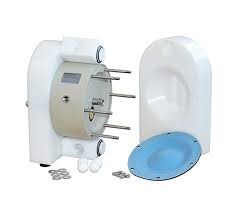
A double diaphragm air driven pump from Tapflo shown with key parts dismantled. Image courtesy of Tapflo.
The answer is yes but we would say low pressures. Process people do have to pump ghastly fluids and there is a market for 100% PTFE with maybe some UHMWP in there as well. Maybe a plastic body. Look at air driven double diaphragm process pumps like units from Tapflo. Here, pressures are very low at maybe 8 bar, allowing you to use a ptfe flexible diaphragm to provide the volume change in the actual pumping chamber. That’s fine for low pressures but does not translate to high pressures as a ptfe diaphragm won’t mechanically be strong enough for the pressure. Look at a basic pump and the inlet and outlet check valves are the other components to focus on. People do use ptfe seats in ball check valves and PTFE o rings on poppet valves, so we would say that issue can be sorted out.
Could you order in mainstream hydraulic components with 100% PTFE seals?
The very simplest components with static seals might be fine. Move to anything more complicated and interchanging seals is more complicated. PTFE doesn’t work like an elastomeric seal, so seal housings need modifying for a different type of seal. So, could somebody offer a pump with a PTFE plunger seal and PTFE check valve seats? Yes. We would suggest a spring energised lip seal for the plunger, albeit at quite a high cost and with issues on complexity in fitting it. Whereas an elastomeric seal will commonly pop into a totally closed groove, the spring energised lip seal is very rigid and would be fitted into an open groove or counterbore with a circlip of washer to mechanically close the groove. This excellent Marco seals article explains the issue with designing housings for spring energised seals. There is that extra complication. That is our take having used these here and there over the decades.
Does a FPE encapsulated O ring sort the problem of a universal seal compound?
We would say no. FPE is a very similar compound to PTFE but is more flexible. Various suppliers offer FPE encapsulated O rings. From our experience, a true FPE encapsulated elastomeric o ring still seems hard and seems miles away from the properties of even a 90 shore o ring. Don’t confuse TFE encapsulation with spraying the elastomeric material with a ptfe suspension such as Xylan coating or even just rumbling a batch of O rings with a fine ptfe powder. This might be called “PTFE impregnation.” We don’t reckon this provides the ptfe barrier. We would get expert advice on application of FEP encapsulated O rings from somebody like this Dutch firm O ring Stocks. Sure, this type of O ring will be excellent in static applications. Solid PTFE o rings are very widely available as well from people like Claron. We use quite a lot of these, but only static applications. We would say that a PTFE o ring isn’t any good in a dynamic application, as it doesn’t have the elasticity. Please tell us about your expertise on FPE “coating” of elastomeric seals.
Conclusion
This is an interesting question for hydraulics people but is it real world? Do I need a universal seal compound? This is our take after over 40 years.
A small sector of the market finds this very useful, for example process people where a PTFE sealed pump makes their job easy. Their pump will cope with almost anything, even if the fluid can’t really be characterised. That is a niche need. They order the PTFE pump as standard. Maybe UHMWP might displace some PTFE seals in view of the ongoing issues with PFAS “forever chemicals.” We think this is a direction of travel that needs to be taken seriously.
Commercial hydraulics people running mineral oil probably don’t care. They would just use nitrile/buna n NBR, viton FKM elastomer or polyurethane at low cost.
Your fluid might require a pumps to be specified with PTFE or Kalrez FFKM for a one off. Kalrez FFKM will be costly. We can fit Kalrez/FFKM seals on our Micropac pumps. That’s a solution. The cost is generally relatively high, although our equipment is always very competitive on price.
If somebody wants to switch fluids backwards and forwards, we are not sure. For example, a pump switching from skydrol oil to DTD 585 moves from peroxide cured EPDM to nitrile/viton and maybe back again. We would be very nervous about managing to flush the pump out. Our solution every time would be to offer a pump that was easy to swap seals and offer inexpensive service kits from stock. That’s our ethos. Or buy two pumps and we label them for our customer.
Contact us to discuss your Micropac pump applications. After over 40 years, we are the hand pump experts.

Leave A Comment