
How to use a Micropac pump for your Aerospace GSE or Defence application.

Micropac pumps have been used for decades for filling, testing and specialist GSE service fixtures for aircraft undercarriage.
For over four decades, our Micropac pumps have been used worldwide in the hangar, logistics depot, on the runway, in the plant and in the field. Over all that time. customers have specified our Micropac pumps and shared our specialist expertise.
We provide a high quality but cost effective British hydraulic product capable of being configured for an enormous range of applications. We talk the language of aerospace and defence. Let’s discuss the main applications. We would say these are:
-Top up, bleed sets and charging carry-arounds and carts.
-Hydrostatic pressure testing of systems or components.
-Installation fixtures in GSE tooling.
-GSE Maintenance and testing to meet manufacturer requirements.
-Enhanced Service Carts for that provide improved productivity and quality in servicing.
Application 1. Filling, top up and charging carry-arounds and carts. Everyday solutions for GSE (Ground Support Equipment) and defence.

A Micropac MP series carry-around fitted with 10 litres/2.6USG reservoir.
As Micropac filling, top up and charging carts/carry-arounds are a core competence, we have seen a lot of applications over four decades. These are our basics for our customers.
How do I know what fluid is in a reservoir? Often overlooked as a basic need.
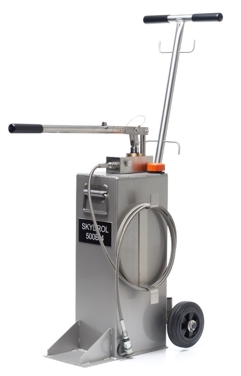
A label identifying this as a skydrol filler is vital. Ask us to fit one.
We commonly fit label brackets to allow customers to use their own standard labelling for plant and reservoirs. Or talk to us about adding specific warning or identification labels to a Micropac pump as a cost effective option. The unit is then ready to use with no additional work for the customer.
How can I ensure my aerospace or defence hydraulic fluid is clean?
This is a key question for users of our Micropac filling units and indeed any user of a system with a reservoir. Dirt and water are the enemies.
Let’s unpick this.
Why is cleanliness important?
Hydraulic cleanliness is a massive issue. There is a lot of background on the web. One article from Servo Kinetics is here. You simply don’t want “dirt” in a system. Different systems have varying levels of tolerance. A very agricultural system might inevitably end up with “dirty oil”, having filth in it visible by eye. Conversely, servo valves on an aerospace hydraulic systems will require ultra clean fluid. Whether it is the risk of particles jamming in valves, causing wear, damaging seals or no end of other modes of damage, contamination is a real issue. Then add in water and issues with corrosion or degradation of hydraulic fluid. Is water the hidden enemy in hydraulic systems? Maybe.
Source fluid cleanliness.
The fluid that is being emptied into a Micropac reservoir needs to be clean. Our MI series skydrol dispensers offer a neat connection into standard “skydrol” cans and drums plus a neat carry around 2 wheel cart. That’s a solution. Similarly, the MB series drum pump will connect into the 2 inch NPT/2 inch gas filler on a drum. That is perfect for some applications, you won’t be building up much pressure and have no means of releasing pressure back to “tank.” That would contaminate the virgin clean fluid. This is a very basic consideration. Do I want to dispense fluid from a clean drum or will I decant my fluid into a Micropac reservoir and pump from that? A manufacturer’s drum or can is supplied to a level of cleanliness, at least until it is opened at which point even the air degrades this figure. That is reality. So, be quite clear on your expectations on cleanliness.
A corrosion resistant reservoir.
The reservoir itself needs to be clean and have a large enough opening to effectively clean the reservoir out periodically. The reservoir material needs to be inert enough to not corrode. We are fans of 316 stainless steel, although anodised aluminium alloy will provide a cost effective and low mass alternative.
Beware water build up from an air space.
An air space inside a reservoir is inherently a risk. Temperature swings will give rise to condensation which causes water build up in the fluid. Confront this by working with a very small air volume or even fluid contained in a flexible moulded bladder in the reservoir so there is no air space at all. You can use a pressurised filler breather to reduce the flow of external air in and out of the reservoir. This can reduce the problem. We have used the Elesa SFW pressurised filler breather cap for years and think highly of them. Another option is a desiccant breather cap to absorb water as air travels in and out of the reservoir.

Elesa SFW Pressurised filler breather. We are fans.
Keep the fluid clean from external dirt.
So where does external diret come from in the hydraulic fluid. We have already talked about tipping “clean” fluid from a drum or can into a dirty reservoir. Maybe using old and dirty fluid rather than new. Let’s also add the additional issue of providing decent filtration as air moves in and out of the reservoir. This applies to both conventional “straight through” and the more complex pressurised filler breathers. The filler/breather cap must stop external contamination from getting into the fluid and this is achieved to a reasonable extent by using a filter element.
A Desiccant breather uses a desiccant gel to pull the water out of the air passing into the reservoir.
They are used in aerospace and defence, particularly where an atmosphere has to be kept dry. Desiccant breathers are not something we have used very often. The desiccant material does become wet and needs replacing or drying out.
An external filter is often specified.
Customers commonly ask for a high pressure in line hydraulic filter. These can be expensive if they incorporate bypass refill valve and clogging indication or are stainless steel. An alternative is a Micropac inline filter that uses an industry standard element that is replaced regularly. Please talk to us to discuss filtration.
Reservoirs are our speciality. Please contact us.
Is there a Micropac air driven pump?
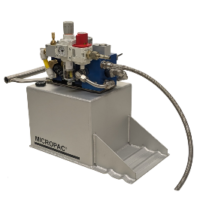
Micropac PTR-X air driven pump/carry around reservoir unit.
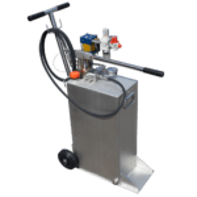
Micropac DUO Air Driven pump/2 wheel cart with integrated hand pump to offer backup and fine adjustment of pressure.
Yes, we are great fans in the right application. Our DUO air driven pump cart with a hand pump integrated is an invaluable unit for many users who can’t be 100% sure that they have an air supply. Or technicians use rapid flow from the air driven pump to simply fill a system or complete a low pressure test. Then the hand pump will be used to adjust the pressure accurately or run to higher pressures. If you require 100% air driven, our PTR-M skid is a rugged solution or our PTR-X compact air driven carry-around or cart. Please contact us.
Can Micropac equipment fly?
No, our equipment is not FAA or CAA certified to fly.
Application 2. Hydrostatic pressure testing of systems or components.
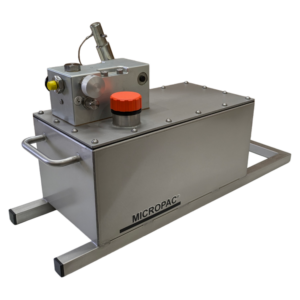
A Micropac PSP two speed hydrostatic pressure test pump offering 5 pressure ranges up to 1000 bar.
Take all the considerations outlined on basic top up and charge units then add the ability to perform a functional pressure test, a proof test or burst test. Watch our explainer on pressure testing.
Can Micropac pumps carry out my hydrostatic pressure testing task? Micropac pumps can be configured to test from 1 bar to 1000 bar over a large range of models. Specify which of our models, single or dual speed, anodised aluminium or 316 stainless, valve options, pressure gauges and hoses/fittings. Plus, our DUO, PTR-M or PTR-X air driven pumps for your air driven requirement. Tell us what you require for your application. Please contact us.
Application 3. Installation fixtures in GSE tooling.
Hydraulic cylinders are widely used for clamping, Work holding and alignment in aerospace assembly and servicing. We have supplied our Micropac pumps with our own miniature cylinders or in conjunction with Enerpac cylinders. There are a massive range of legacy application. We see lots of these applications on GSE drawings. Alignment mechanisms, compressing springs, clamping and much more. Talk to us about your GSE tooling application. Please contact us.
Application 4. Maintenance and testing to meet manufacturer requirements.
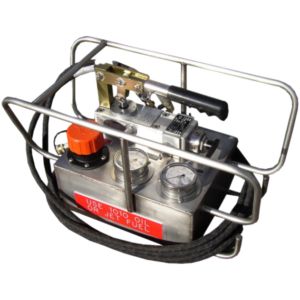
Our version of a VGV actuator test unit sold to airlines for over three decades.
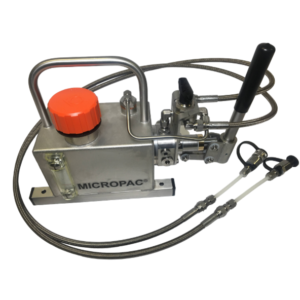
Miniature aerospace fill & bleed unit from standard Micropac parts
Over decades, aerospace operators and equipment suppliers have asked us to provide equivalents to OEM units. Sometimes legacy units are using obsolete parts or supply is no longer practical. We are very clear when we are offering equivalents. The list of equipment is long, including brake filler units, undercarriage test equipment, cowl reverser test units and VGV actuator test unit.
Picking one specific unit that has been supplied for decades, the variable guide vane actuator test unit. This achieves a test procedure called up on specific CFM engines.
There are always new maintenance and testing applications that arise for our equipment. For example, a small displacement Micropac pump with an integral leakproof four way directional valve to set up and commission a defence system in the field. The unit included a small reservoir and a small skid with hose stowage plus specific hose terminations. Talk to us about your application. Please contact us.
Application 5. Micropac TX Service carts for that productivity edge in GSE and Defence servicing.
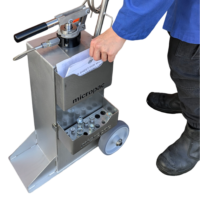
Micropac TX carts include fitting and document stowage as a neat add-on.
For users of a Micropac hand pump and two-wheel trolley cart, move to a more productive option with our Micropac TX series service carts. This is a simple and cost-effective upgrade. After over four decades, we know that not being able to find hydraulic fittings or test fixtures when you need them is massively unproductive. Add in the need to keep manuals and certification safe with the test fixtures and our service cart option integrates storage boxes and trays into your Micropac TX cart. Cleanliness is also vital. Retaining fittings in their own location with dust caps or in a bag is very valuable. Caps will stop mechanical damage to a thread or finches on the profile.
There is a true productivity angle on our Micropac TX carts. Talk to us on your application for your site. Please contact us.
Summary.
Micropac pumps have served defence and aerospace applications for over four decades. They are UK made, well-engineered and cost effective. These units are part of our large range of hand and air driven pumps running up to 1000 bar on multiple fluids, in a range of materials including 316 stainless and offered in permutations such as ATEX/IECEx certification. If you need to discuss your application further, please contact us.

Leave A Comment