
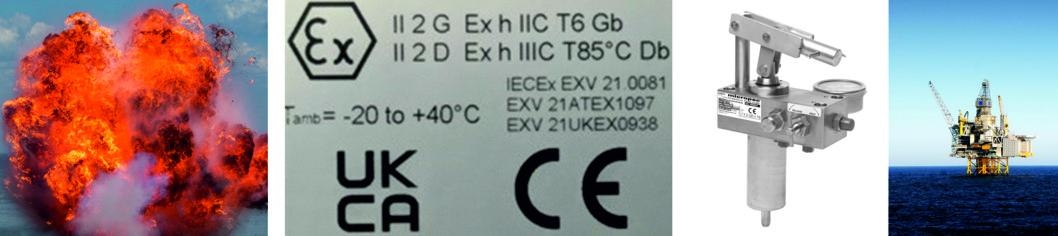
There are lots of hazardous areas in daily life and the larger world. We are focussed on one particular type that has been with us for a very long time. We all live amongst hazardous areas where there may be a risk of an explosive atmosphere. It is more common than you might think. Think of liquids that give off a flammable vapour. Add in various tricky manufacturing processes, some of which go back to medieval times. Go further back to mining and working underground even into prehistoric times. Hazardous areas with an explosion risk have been intertwined with human lives throughout history. When something goes wrong, the results can be anything from a ‘near miss’ to a human and environmental catastrophic; history is littered with accidents that have occurred through inadvertent ignition of a flammable atmosphere. Think about the 2005 Buncefield oil depot explosion where a fuel tank overflowed and created a large area of flammable vapour which then ignited.
Identifying these hazardous areas and ensuring that activity and equipment within them does not cause explosion is the central issue. If people talk about “explosion proof equipment”, this describes gear that won’t cause an explosion when operated.
Let’s provide some of the background.
What are hazardous areas? What are potentially explosive atmospheres?
A hazardous area in our context is an environment where there is an explosion risk due to flammable gases, vapours or dust. It may be defined as ‘any place in which an explosive atmosphere may occur in quantities such as to require special precautions (i.e. the construction, installation and use of apparatus) to protect the safety of workers’. Regulations relating to potentially explosive atmospheres are concerned with control of ignition sources that may give rise to an explosion. There are many forms of an ignition source that must be considered within a hazardous area; these include naked flames, hot surfaces, sparking caused by impact or electrical contacts and electrostatic discharges.
Is an explosive atmosphere the same as storing hazardous chemical substances?
No, it isn’t. Although the end result can be equally catastrophic (witness the 2020 Beirut Dock Explosion, caused by careless storage of an explosive substance over a prolonged period), in the context of an explosive atmosphere we are not concerned with storage, handling, use or disposal of dangerous substances where, for example, inflammable chemicals could under certain conditions spontaneously combust, or careless handling could cause an explosion.
Different sets of regulations apply to these two types of risk, although both may apply dependant on the area.
What is the ATEX Directive?
The ATEX Directive 2014/34/EU is an EU Directive concerned with specifying minimum safety requirements for workplaces and equipment used in explosive atmospheres. It has been adopted by all EU member states and is written into law within each member state.
Following Brexit, the UK continued to adopt the ATEX Directive through UKEX regulations and enshrined within UK law under ‘The Equipment and Protective Systems Intended for Use in Potentially Explosive Atmospheres Regulations 2016’.
Why do I need ATEX certified equipment?
If you are operating in a hazardous area, it must be assessed and classified according to prevailing regulatory requirements. It then follows that certain equipment (so called Ex equipment) used within the hazardous area must meet defined requirements in terms of control of ignition sources. Many of the standards relating to hazardous area classification and control of ignition sources in Ex equipment have been developed and implemented on an international basis (ISO standards).
Does a hydraulic hand pump used in a hazardous area need to be ATEX certified?
Certain equipment is considered ‘out of scope’ of ATEX. Specifically, in terms of non-electrical equipment, the Directive is concerned with equipment where there is stored energy, as this may potentially give rise to a hazard. In consideration of hydraulic equipment, an accumulator would be within scope since when pressurised there is energy stored in the spring. In certain instances, a hand pump would not be considered within scope; an oil dispenser at zero pressure would be a good example of this. However, since our Micropac pumps operate at pressures up to 1000 bar, there is an implied element of stored energy both within the pump itself and within the hydraulic system to which it is connected. This is both by virtue of compressed fluid and of any components such as hoses and vessels that may expand under pressure.
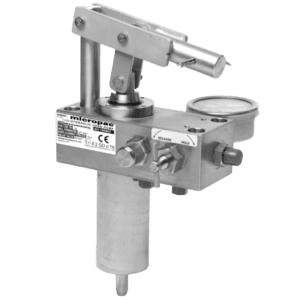
Typical Micropac MW series hand pump that can be supplied as ATEX/IECEx variant.
When risk assessing a hazardous area and the equipment used within, it is therefore a safety-assured solution to specify an ATEX-certified hydraulic hand pump, thus eliminating any risk that the equipment may be a possible ignition source. There are numerous areas for potential risk, such as materials of construction that could cause sparking and use of polymers that could create build up of static charge. We provide the solution.
Is there any difference between ATEX, UKEX and IECEx?
The ATEX Directive covers equipment and protective systems intended for use in potentially explosive atmospheres. It applies to EU member states, the requirements for which are then enshrined within individual member states legislation.
In the UK, the equivalent UKEX regulation and associated legislation called ‘The Equipment and Protective Systems Intended for Use in Potentially Explosive Atmospheres Regulations 2016’. Following Brexit, the UK introduced UKEX as a requirement for certifying and marking equipment for use in potentially explosive atmospheres. This process mirrored ATEX requirements but required the use of a UK Government-approved body for equipment certification. In the same way that ATEX product bears the CE marking, UKEX product was to bear the UKCA marking. If fully enforced in the UK, it would have meant that equipment certified to identical standards would have to be UKCA marked for the UK market and CE marked for the EU market; CE-marked product would not have been allowed to be placed on the UK market. However, the deadline for all UKCA marking was delayed repeatedly and has now been postponed indefinitely. Equipment bearing the CE marking may continue to be placed on the UK market.
IECEx stands for International Electrotechnical Commission Explosive and is an international certification scheme for equipment for use in explosive atmospheres, operated by the International Electrotechnical Commission (IEC). Design requirements are based on the same ISO standards as used for ATEX compliance, but quality assurance requirements may differ. Certification of product to IECEx is acceptable for some non-UK and non-EU countries.
How do I interpret the codification of ATEX equipment?
The CE marking and ‘Ex’ symbol denotes that the equipment is ATEX certified for use in a potentially explosive atmosphere. The lettering coding following on denotes compatibility of the equipment within the operating environment, including equipment group, safety category, environment, explosion protection, protection concept, gas group, temperature class, and equipment protection level.
There is an excellent guide on the web from LCM Systems.
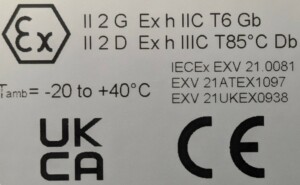
An ATEX rating label from a Micropac pump. An engineer will read this, interpret the data and ensure the equipment meets the needs of the project.
Is there any crossover between the PED and ATEX requirements?
These are very different directives; whilst both are concerned with setting minimum safety standards, one deals with pressure equipment and the other deals with explosive atmospheres. It is possible though that equipment may have to satisfy the requirements of both directives, as in the case of our hydraulic hand pumps for use in potentially explosive atmospheres.
What equipment can Sarum Hydraulics offer for ATEX?
We offer a selected range of our Micropac hydraulic hand pumps and reservoirs that have been certified to UKEX, ATEX and IECEx requirements. See our website for more details.
MP Ex 316 Pressure test Pump with Reservoir
MD Ex 316 Two Speed Hydraulic Hand Pump
Is the ATEX certificate the same as a certification to ISO 80079-36?
We were recently asked this question. The ATEX Directive is concerned with specifying minimum safety requirements for workplaces and equipment used in explosive atmospheres. ATEX cross refers to any relevant design standard concerned with product design of equipment and components for use in an explosive atmosphere. ISO 80079-36:2016 is one such design standard and specifies the basic method and requirements for design, construction, testing and marking of non-electrical Ex equipment.
Can I risk assess my own equipment for use in a potentially explosive atmosphere?
No, you can’t. In the UK and EU, if equipment for use within a hazardous area is within scope of the ATEX Directive, it must be ATEX certified. Elsewhere, it must be certified to the prevailing regulatory requirements e.g. IECEx.
To clarify, in the EU and UK, once the classification of the hazardous area is known, the risk assessment of the area would include specifying ATEX certified Ex equipment that is compatible with the operating environment, as determined by the equipment marking according to the ATEX Directive. The risk assessment of the hazardous area should ensure that all risk of ignition sources within the hazardous area have been mitigated.
We offer specialist hydraulic hand pumps as standard catalogue parts, not “specials.”
Forget 18 week lead times and massive prices. After over 40 years of manufacturing our Micropac hydraulic hand pumps in Salisbury, England, we are the experts. ATEX and IECEx units are just one of our products. Contact us to discuss your next requirement.

Leave A Comment